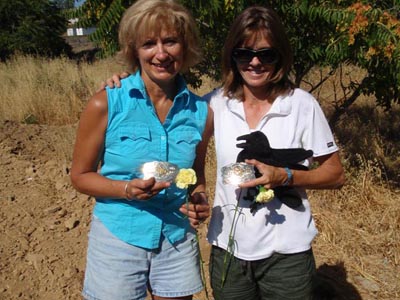
I first became aware of the Tevis when Pat and I became introduced to Endurance Riding while living in the Pacific Northwest. While it was interesting to follow the race over the years, I never really thought the opportunity to ride the event would present itself.
My journey to ride ’09 Tevis began during a conditioning ride on Super Bowl Sunday in ’08. Kathie Perry and I were getting in a quick ride that morning at Folsom Lake before heading off to our respective Super Bowl events. During our ride, Kathie asked if I had any interest in riding Tevis. I replied yes, and asked if she would help me prepare. Her response was that she would, but I would need to give it my full commitment.
Read more here: Steve Hallmark and Tug, Tevis 2009
Have a Tevis ride story you want to share? Email a copy of your story to tevisfeed@gmail.com with the subject line "Tevis Story". You can include pictures with your submission, but please ensure that all photographers are given appropriate credit. The goal is to make this blog a compliation of various peoples' (riders, volunteers, and crew) experiences with The Tevis Cup - Western States Trail Foundation 100-Mile One Day Trail Ride.
Showing posts with label 2009. Show all posts
Thursday, January 15, 2015
Wednesday, January 14, 2015
Kevin Myers and Far, Tevis 2009
Quoting Julie Suhr: How Will You Know How Far You Can Go Until You’ve Gone Too Far?
Far and I took on the ultimate challenge last weekend and I daresay we are both stronger beings as a result of it, and I have yet to find my own answer to Julie Suhr’s question. . .
I have felt drawn back to the Tevis trail since riding it two years ago on a wonderful horse lent to me by a generous friend. There is not a more challenging trail and there may only be a few trails on earth more beautiful and more liberating than the Western States Trail. I have yet to find them. I rode in Easyboot Glue-On boots this year, and the difference from riding in steel shoes was quite remarkable.
Far is one of those horses you know will only cross your path once in your life. I am fascinated in his curious mind and by a fire that burns in him very deeply. He grew up in the large open spaces of the mountains in the interior of British Columbia and he loves life.
I have transitioned three of my own horses to barefoot in the last 13 weeks and I have been around many other horses in the area who have decided to make the move from steel shoes to barefoot. Each horse responds very differently to the change and Far has been the horse who has adapted the most easily of them all. His movement barefoot and in the Gloves and Glue-Ons seemed immediately more comfortable for him than in steel shoes, and his feet look better than they ever have. It seemed fitting, then, to take on the challenge of the Tevis trail: what better test for the latest in many years of equine boot technology?
Far and I managed to pre-ride most of the last 17 miles of the trail into Auburn in various sections with Leslie Spitzer in the week prior to the ride. We went up to Robie Park on Thursday – and I’m glad we did. We got a better choice of camp spots and it gave us a chance to get the Glue-Ons applied by Garrett and the EasyCare Team before pre-riding the first few miles of the trail. Far was a monster on the pre-ride on Thursday and I wondered if he would be too much for me at the start line with 180 horses around him. It weighed heavily on my mind.
The start was smooth – other riders were polite through the controlled walking section to the official start line. He had a quick moment of panic when he crossed the first footbridge and stepped his left hind off the bridge entirely – just long enough to realize he would not be able to touch the ground with that leg before pulling it back up and continuing on. That was one of the few times I looked down to see if the boot was still on – it was. I was further back in the crowd than I wanted to be – the speed was already slower than I wanted and I knew we had to get ahead of some of the groups if we were to ride to the strategy we had planned.
We managed to dart past about 40 riders before we got down to the ski-hill road: we were riding in tune with each other, each of us knowing what the other wanted. He felt strong – very strong – and we walked and trotted up the Squaw Valley towards Emigrant Pass before coming to the first water and hay at High Camp at 13 miles. He demonstrated almost none of the tripping I remembered from the previous year and the boots felt like they took the much of the concussion out of the hard-packed road. It was like jogging in running shoes.
We pulled into Lyon Ridge at 25 miles and trotted through. I refilled water bottles, let Far eat and drink for a few minutes and continued on up and over Cougar Rock. What a rush to be back on that rock with a horse I know and trust so well. The boots took all the slip out of the rock – it really felt like we were riding on suction cups across the rock face as we climbed. I looked back over my shoulder and enjoyed the breathtaking views. What a sight: those images will keep you coming back for more.
Far ate up the miles to Robinson Flat voraciously, flying down the road as it rose and sank all the way to the first hold. In the prior year the road seemed like an unforgiving section of trail because it was so hard. This year I hardly noticed because the foot lands so much softer in boots. I was soon sittting in the shade of a pine tree enjoying a tuna salad sandwich and a Starbucks Double Shot. My trusty crew made up of Rusty, Bill and Leslie all know me and the horse well enough that I did not have to think.
I stayed for ten minutes at the Deadwood vet check while he ate and drank before setting off down the 2,665 foot descent to Eldorado Canyon.I remembered the trail as being somewhat scary because of the drop-offs, but I have so much trust in this horse that it seemed like we were meant to be there, adding up the miles at a good speed. Far felt fresh and eager and we were soon approaching El Dorado Creek. Far tanked up on fresh water and then we set off back up the canyon towards Michigan Bluff.We walked and trotted our way down the 1,700 foot drop to the infamous Swinging Bridge. I got off and hiked the steeper sections. We spent a few minutes down at the bottom while he drank from the river and I crossed the bridge on foot. As the bridge began to swing ever so slightly, Far’s pace quickened considerably and I found myself holding him back behind me. For a moment I though he might start to run, but we got to the other side without incident and I remounted for the 1,565 foot climb up to Devil’s Thumb.
I tailed him about 90% of the way up. I arrived at Michigan Bluff fairly dazed, but Far looked great and the trusty crew was there to give me encouraging words and steer me in the direction towards the Chicken Hawk vet check. We trotted along the road with the comforting feeling of the boots gripping the asphalt. Far felt like a freight train – strong and willing and eager. The boots just seemed to give more spring to Far’s already lofty gait.
We paused for a while at the Chicken Hawk vet check: he vetted through with lots of spring in his trot before setting off towards the milestone of Foresthill. Climbing up Bath Road is such fun – people are lined along the street in the chairs – they clap and cheer when you arrive. One of the people in the crowd asked me if I was using spray-on boots. Glue-Ons are probably the closest thing I suppose! Far vetted through without any issues and I enjoyed the hour hold immensely by eating a tuna salad sandwich and a huge bowl of home-made fruit salad.
I had fun this year trotting through the town of Foresthill– not even changing my speed as we trotted across the black-top, much to the shock of the volunteers who were convinced we would slip as we went from trail to road. I remember thinking the slight downhill grade last time was risky as the hind shoes slipped a little as we walked and trotted our way down to the trail. This year was very different – we skipped through town at a nice clip without even so much as a skid on the slick pavement.
I was fortunate to have more than an hour of daylight to get me through the most technical parts of this trail and I managed to make up some good time. I was grateful to catch up to Christina and to enjoy her good humor and good conversation. Dave Rabe would catch us a few miles before getting to Francisco’s in the soupy blackness along the rest of the California Loop. It was an enchanted night.
We arrived at the Francisco’s vet check at 11:19. The volunteers were punchy and the food for horse and rider was plentiful. The vets were plucky and so was my horse. Dave and Christina both agreed we should continue riding together, and off we set. When Christina got to the road, she trotted off and we stayed at a walk. We should have stayed with her: we missed the trail turn-off at the bottom of the hill and instead walked most of the hill up before realizing there were no ribbons and no glow sticks. We probably lost about 20 minutes in the process. We hand-walked and cussed our way back down the hill to the turn-off and rode the single-track trail for the three miles to the American River crossing.
It would take us just over an hour to finish the last five miles of trail. We were riding to make sure the horses finished without issue and there are some technical sections down there in the blindness. Far marched his way up the final hill to the finish line. He drank, vetted through, and was pronounced fit to continue. The buckle was ours: what a horse: is he a horse!
Friday, January 9, 2015
Bruce Weary and John Henry, Tevis 2009
“Many people know that this was my seventh attempt at Tevis...”
I am writing this little memoir at the flattering request of an embarrassing number of good people who, for some reason, have taken an inordinate interest in my horse and our completion of the Tevis this last Saturday (and a good part of Sunday). There is so much to tell, that I just couldn't seem to boil it down to one title, as it is really a story of the wonders of the ride itself, as well as the horse that carried me through it. I will have to write in installments, as I want to do this ride justice, but also don't wish to bore anyone. So if I ramble on too much, I hope someone will be kind-hearted enough to tell me to please shut up!
Many people know that this was my seventh attempt at Tevis, and though it honestly never occurred to me to quit trying or to be embarrassed about my past failures, I was painfully aware of the disappointment and vicarious suffering endured by my wife and the many friends who have pulled for me over the years. It was really for these people, more than myself, that I wanted to finish this time, and why we trained and prepared so fully over the last year. I felt it was the least John Henry and I could do in return for the friendships and support we had enjoyed all along. Inspiration is where you find it, and I found it in some unusual places: Winston Churchill's shortest and most famous speech, "Never give up. Never, never, give up." The 2004 Tevis video. The match race in "Seabiscuit." The immortal words of that 21st century philosopher, Rocky Balboa, who said, "It's not about how hard you can hit. It's about how hard you can get hit, and keep moving forward." I know, it's cheesy, but it worked for me. As far as inspirational people, there were many, some of whom certainly deserve to be mentioned here. First and foremost, my wife, Dayna. She is not only the love of my life and my very best friend, she has offered the greatest support and the harshest critical insight when I needed both. She has foregone her love affair with the Tevis trail for several years so that I might keep trying. She is known in familiar circles as the "Crewing Queen," a title that is extremely well deserved. Though she owns a 50th anniversary buckle, she has more Tevis dreams of her own, one of which is to wear a 1,000-mile buckle someday. Thank you, honey. I could not have achieved this goal, nor the life I have, without you. I love you.
Then there are people like Barbara White, who has become our friend, confidante, advisor and co-captain in getting Dayna's horse, Crickett, to the Tevis finish line twice. Barbara earned her record 28th and 29th buckle on Crickett, and we think it only fair that the least she can do now is put him through college before returning him to us. :) Thank you, Barbara, for wanting this as badly as we did. Barbara's mother, Julie Suhr, is an inspiration to so many, including Dayna and I, and I guess one can have no stronger mojo working in your favor at Tevis, than to have Julie pulling so hard for us. They say that in order to finish Tevis, you must make peace with the "Tevis Gods." I think the Gods knew that if we didn't finish, they would be hearing from Julie Suhr, and it wasn't going to be pretty, so they left us alone on ride day. Julie's husband, Bob, though usually content to quietly reside in the background while everything Tevis swirls around him, is a man I would very much like to resemble when I grow up. He is remarkably funny, principled, an accomplished endurance rider, and openly adores his bride. Any man would do well to emulate him. Thank you, Bob and Julie.
Without a doubt, the most important figure as far as actually helping me to effectively prepare John Henry for what he would face on the Tevis trail, thus assuring our success, is Michele Roush, DVM. She agreed to be my coach very early on in our training. She is extremely knowledgeable, detail oriented, and thorough. I learned more from her about how to condition a horse than I had learned in 25 years of endurance riding experience. Michele, we simply would not have finished had it not been for your coaching, insight, strategies and steerage on ride day. Though I was often not the best student, we nailed the final exam! Thank you so much for your friendship, patience and guidance.
Other notable people include Dick Dawson, Dr. Susan Garlinghouse, Karen Chaton, Bruce Anderson, Dr. David Nicholson, Ron Barrett, Jeanetta Sturgeon and a host of others who, at one time or another, added inspiration or a piece to the puzzle. I hope you all know who you are. Thank you.
Though I had ridden Arabs for most of the 25 years I have been doing endurance riding, about six years ago, I became curious about gaited horses and began experimenting with them. I have had several in that time, and had some success, especially with a Foxtrotter mare, named Sugar. She and I failed at Tevis in 2007, and shortly thereafter I moved her on to a nice lady who trail rides, and began looking for my next candidate. I found a horse broker, Fred Mau, in New Mexico, and flew over to look at his herd. I sifted through several horses, and decided to take John Henry, an eight year old TWH, on a test ride. We went about 15 miles, and I noticed how sure-footed and good-minded he was, as well as smooth gaited. At one point we tied the horses to a tree so we could hike a short distance to see a unique waterfall. When we returned, Fred and I noticed that John Henry had come untied, but was standing stock still exactly where I had left him. "Oh yeah, he ground ties, too," Fred said.
A few minutes after we got back, I caught his pulse at 32. He impressed me enough to bring him home. I spoke to JH's original owner, who raised and trained him. He had been a working horse all his life, having done everything from carrying ten year old children to serving as a pack horse in the mountains on elk hunting trips, so he was used to hauling weight up and down hills. Being reasonably fit already, I took him on his first 50 miler two weeks later, which he finished easily, and nearly top tenned amongst some eighty horses.
Well............that got the wheels turning. The more Dayna and I watched this horse, the more we were fascinated with him. He is the most "human" horse either of us has ever owned or been around. He "talks" (nickers) to any person he sees, and if you go away for 30 seconds and come back, he will greet you again as if you'd been away for a week. He is demanding at feeding time, and will stand three legged, with one foot carefully placed in his hanging feeder until we arrive with his ration, then gently remove it and begin dining. He has an unrivaled appetite, drinks well, trailers and camps like a pro, and will even lie down when tied to the trailer and never disturb his surroundings. All well and good, but then that question to my wife popped out of my mouth, in a moment of weakness and fantasy, "Do you think he could finish Tevis?" God bless Dayna, she usually lets me roll with my wild ideas until I either succeed or it's clear I'm going down in flames. "You're going to need some help," she said. "Call Michele Roush and see if you can get her to coach you," she added. Knowing there would be groveling involved, I wrote Michele, who took pity on me, and agreed to offer her services in our quest for Tevis gold. She had already been coaching Dayna with her horse, Crickett, and has a supreme record both as a rider and a vet, so I know she was sticking her neck out a bit to work with an unproven gaited horse, and a rider who had stepped up to the plate and struck out six times previously at Tevis.
After John Henry had done a half a dozen 50's Michele had us reduce our ride schedule, and be more selective in the type and difficulty of the rides we attended. We did more specific conditioning at home, and I think the turning point for John Henry took place at Mt Carmel. We decided to try to do all three days, and see if he stood up to the task. Barbara White rode with us on Dayna's horse,Crickett, those three days, as she was preparing to ride him at Tevis herself. Now, Barbara has been around a bit, and ridden and known some pretty good horses, so I felt she was a good sounding board, and could offer objective opinion about JH, if she rode along side him for three days. Needless to say, we were both astonished at what he accomplished that weekend. He not only kept up with Crickett, who is no slouch, but he got stronger and faster each day, and more amazingly, recovered at the same time Crickett did all weekend. We never had to wait on him. Of the 20 horses that did all three days, Crickett and John Henry finished 5th and 6th.
Okay, so now I'm getting a rash. The kind you get when you know you might just get to show up at Robie park with a horse that has a chance. Michele designed a workout program to peak JH in the weeks prior to Tevis, and we also took him along with Crickett to the Tevis Educational ride, to show him the trail and see if he could handle carrying me out of those challenging canyons between Last Chance and Foresthill. Not only did he, but he led our group much of the way. He became the mascot, as several of the riders wanted to ride near or behind him due to his calm nature. They knew he wouldn't kick, fidget, or endanger the other horses when frequent stops on the trail were necessary. Both horses handled the trail easily, and after that, Julie Suhr wrote and said, "Now put them both in bubble wrap, stick them in the freezer, and don't let them out until Tevis." Which we promptly did. I was always taught to respect my elders. Finally, it came time for Dayna to take the horses and head to Robie Park. I stayed home to work and flew up a couple of days later, and arrived to see two well rested, well fed horses, waiting to venture off into the Sierras. Barbara and I had a lovely pre-ride on Friday morning, just to get the kinks out and get a look at the first stretch of the trail. John Henry is a very good downhill horse, and he also needs about four miles to get his "machinery" warmed up, and to let his heart rate settle in at aerobic levels. The Tevis trail offers the perfect start for him, as it is downhill for a little over six miles down to the Truckee River. Though Crickett and John Henry were very attached to each other as they rested at camp, they have no separation issues once the ride begins. Barbara headed toward the starting line, while I took John Henry off in the opposite direction, to let him warm up. We planned to not ride together, as Crickett's pace would be undoubtedly faster, and I wanted to keep JH at a pace that worked for him.
The trail was in very good condition, and had been widened in many places, so there was really no risk of getting trapped behind other riders. Michele Roush had carefully worked out a time schedule for us, which I tried to adhere to as closely as possible. John Henry was good about both passing other horses, and being passed without a fuss, as we made our way down to the river and up the other side toward High Camp. However, I had to stop to pee once, and he did circles around me while he watched other horses passing us by. I hate that, and it's why I never wear my good shoes. :) I kept a close eye on his heart rate as he powered up the service road through Squaw Valley, and I think we beat our time schedule to High Camp by a few minutes. One thing Michele grilled me on was to stay focused when I arrived at any stop. I would look for the water, feed, PR people, the vets, and then track my time so as not to squander time needlessly. This was crucial to getting through the day without running overtime, or feeling like I had to ride faster to make up for wasted time. We had practiced our electrolyte protocols, as John Henry would need them replenished throughout the day if he was to continue feeling good and wanting to work. It worked like a charm; in fact, he basically became a freight train in the last third of the ride, at times running along in dark, with his pulse around 118-120. He drank deeply all day and night, and had excellent hydration scores throughout the ride. Thank you, Michele!
We led a group of riders through the Granite Chief Wilderness, aka "the bogs" and his big walk and sure-footedness really came in handy in getting us through there in a timely fashion. We watered at Lyon Ridge, then made our way mostly alone to Cougar Rock (we went around, as I wasn't risking a fall that could end our day) and Elephant Trunk, on the way to Red Star. Things can get clogged up at Red Star, but this time the vets were working diligently to get people vetted and out quickly. We got in, pulsed down, ate for a couple of minutes, got vetted and out, all in nine minutes! Onward to Robinson, I was reminded that this section of the trail is *not* all downhill. I counted at least five climbing sections, and John Henry showed some signs of fatigue here. We were alone, and he wanted to walk the uphills. We finally skated into Robinson around 11:20, about 20 minutes behind schedule. Robinson Flat is always a bustling blur to get through, due to the amount of people, horses and vet lines, which were pretty long this year. We waited to be vetted for about 15 minutes, and John Henry had a 52/52 CRI here. He ate a smorgasbord of feed, took a nap (which always makes Julie happy) and we headed out on time toward the canyons that lie between Last Chance and Foresthill. We had trained hard for these canyons, which have been a source of concern for me ever since I first attempted Tevis in 1994. If you don't know what to expect, or you or your horse aren't fit, they can be overwhelming. We were blessed with cooler weather this year, but those canyons can be very warm and are always muggy, so, long ago I decided that I would be fit enough to tail him out in order to save more horse for later on. I hiked steep hills for several months and used a home video workout program called "P90X," to get in shape. (When I first used it, I thought it stood for "Puke 90 Times") :) These strategies worked, as I was able to tail him out of both canyons, and felt good afterward. My GPS and heart monitor showed that John Henry pulled me out of those canyons at 4 mph, with his heart rate not going over 120. Dick Dawson told me when he saw us at Deadwood, that John Henry had that "look" that told him we would finish. Perfect time to hear that. Many people have asked me at what point during the ride did I begin to feel like we were going to finish. My best answer is "at Foresthill." Pulse criteria at Foresthill is 64, and after climbing out of Volcano Canyon and up Bath Road, John Henry presented at 56. I sought out one of my favorite vets, Jim Baldwin, to do our vet check, as he is very fair, and extremely fast at evaluating a horse. Michele offered to trot him out for me so I could watch along with Dr Baldwin. He looked great, and Jim told me, "Let him rest and get some chow, and he should take you home. You have a lot of horse here." There was a crowd watching his vet check, and as the message rippled through that we would be going on, there was cheering and applause that gave me an adrenaline rush, and, I suspect John Henry, too. Michele saved my bacon again, as during the hour hold she found that JH had sprung a shoe, and she took him to the farrier to have it removed, straightened and put back on while I was eating and taking care of me. There were tears and lumps in throats as my wife Dayna, Julie Suhr, my daughter Elysse, and my crew all realized for the first time that unless I fell off, we were very likely to see Auburn before dawn.
With glowbars on JH's breast collar lighting the way, and a crowd of well-wishers sending us off from behind, we left Foresthill on time, right at 9:00. We were guided down Foresthill Road and through town by dozens of volunteers. Along the way, pockets of people were hootin' and hollerin' and carryin' on to such an extent that it caused me to think to myself, "That's okay. I remember my very first beer, too." :) John Henry's power walk helped us to slowly catch and pass a small group of riders that had gone out before us. One rider asked, "What kind of horse is that?" "A Walker," I replied. "Apparently!" he said. We headed onto the Cal-2 trail, and descended into increasing darkness that was softened somewhat by the 3/4 moon that hung in the humid night air. The switchback turns on this section of the trail are very sharp, and though I had many times been told to simply trust my horse's night vision, I didn't hesitate to flick my flashlight on for an instant every now and then to make sure we were negotiating the turns safely. Our group had a somewhat ghostly appearance as a line of glow bars floating three feet off the ground, and traveling single file ever downward to the American River below. John Henry led much of the way, as the riders behind liked being able to see his glowbars, and his gaiting helped us cover ground faster than a walk, but not as fast as a trot, which some were reluctant to do in this much darkness. I had seen this section in the daylight, and it is very precarious in places. Some who have seen it in the daylight, have refused to ride it at night. However, the darkness mercifully makes it very difficult to actually see the scary parts, so, we continued steadily on through the night toward our next goal--Francisco's. Located some 17 miles from Foresthill, even though we kept moving constantly, it took our group four hours to reach Francisco's, where we were greeted by reassuring bright lights and the friendliest and most nurturing volunteers I had met all day. Francisco's is historically famous for that. John Henry was at 60 when we arrived, and he dragged me to the water and then some wet alfalfa, as he began putting himself together for the last stretch of trail. We vetted out without incident, and I lingered a few minutes and had a sandwich and a cup of coffee while JH chowed down some more. We said goodbye to the volunteers and stepped back into the darkness on our way to the waters of the American River, now only some three miles away. As we approached the river's edge, there were several horses in front of us, and John Henry became unruly, fighting to get around them and into the water. After a few expletives from me, I allowed him to crash into the water, forgetting to lift my feet and legs clear of the water's surface. You know that deep breath you take when someone dumps ice down the back of your shirt? Yeah, that's the one that hit me as my legs became instantly soaked in the chilly but refreshing American River. John Henry had planted himself and began drinking like a Shriner at a NASCAR race. We climbed out the other side, and from that point on, I had trouble rating John Henry. He knew the trail, as he had seen it on the Educational Ride, and apparently his own personal homing device kicked in as he hammered his way down the trail on our way to the Lower Quarry vet check. Some of the faster horses had left us at that point, as time was getting short, and most riders had concerns about making cutoff times. The overwhelmingly bright lights of Lower Quarry were soon in view, and we made our way down the short, steep trail into the vet check which offered a smorgasbord of food, warm blankets, bleary-eyed but cheerful volunteers, and of course, the vets. After we vetted out, I checked the time, and saw that it was 3:20, and realized that we had better get moving, as we still had six miles of dark trail to negotiate. I later found out that my wife and crew were becoming increasingly nervous about my arriving on time, due to the late hour, and the time delay in the reports they were receiving as to our location. I left Lower Quarry and followed Steve Hallmark, a local who knows the trail.
It was very dark, and the glow bars had become few and far between, and I would have been very reluctant to move along quickly along this section, as I had ridden it in the daytime, and I knew there were rocky sections that could be tricky. I owe thanks to Steve, who somehow knew when we could trot and when we needed to walk, and we marched toward Auburn, with the clock ticking down. Finally, we reached the last single track that leads to the Auburn overlook, and as I glanced over my left shoulder, I could see the lights of the finish line, and could hear the faint hum of the generators that gave them life. In just a few short seconds, we emerged out the darkness, arriving at 4:56, with just 19 minutes to spare. We were met with applause, cheering, whistling, bright lights, and a very welcome water tank for John Henry. I sifted through the small but mighty crowd to find my wife, who was sobbing on her cell phone. Julie Suhr had waited at the finish line until around three in the morning, and finally had to retire, but not before admonishing Dayna to call her the moment we crossed the finish line. I would love to hear a recording of that conversation. I asked Dayna later what was said, and she replied, "I don't really know. We were both crying so much I couldn't understand everything she said. She did say to go take care of you and John Henry." My wife knows that I am often unable to speak when I am emotional, so I grabbed her and hugged her for a very long time, as much to regain my composure as to thank her. "You finally did it!" she said. "John Henry did it. I was just along for the ride," was my answer. Michele Roush tracked JH's pulse from the moment we arrived, and she quietly told me to follow her as she led him to the vetting area, and told me he was down and ready to present. The vet checked him over, pronounced him at 60 bpm, and asked for the trot out. Michele trotted him out and before she could turn around and trot back, the vet turned to me, shook my hand and said: "Congratulations, you're done." I must have set a world record for hugging the greatest number of women in the shortest period of time after that.
We led JH to McCann Stadium, and though there were only about three people in the stands, we took our victory lap. John Henry gaited the entire way around, looking sharp and sound. We peeled his saddle off, and led him off to shack up with Crickett, and to get some much needed rest and chow. Dayna had laid out about ten glasses and two bottles of Champagne for each of us to toast the night, which was quickly becoming day. A glowing satisfaction flowed over all of us, that persists, and likely will for some time.
I am writing this little memoir at the flattering request of an embarrassing number of good people who, for some reason, have taken an inordinate interest in my horse and our completion of the Tevis this last Saturday (and a good part of Sunday). There is so much to tell, that I just couldn't seem to boil it down to one title, as it is really a story of the wonders of the ride itself, as well as the horse that carried me through it. I will have to write in installments, as I want to do this ride justice, but also don't wish to bore anyone. So if I ramble on too much, I hope someone will be kind-hearted enough to tell me to please shut up!
Many people know that this was my seventh attempt at Tevis, and though it honestly never occurred to me to quit trying or to be embarrassed about my past failures, I was painfully aware of the disappointment and vicarious suffering endured by my wife and the many friends who have pulled for me over the years. It was really for these people, more than myself, that I wanted to finish this time, and why we trained and prepared so fully over the last year. I felt it was the least John Henry and I could do in return for the friendships and support we had enjoyed all along. Inspiration is where you find it, and I found it in some unusual places: Winston Churchill's shortest and most famous speech, "Never give up. Never, never, give up." The 2004 Tevis video. The match race in "Seabiscuit." The immortal words of that 21st century philosopher, Rocky Balboa, who said, "It's not about how hard you can hit. It's about how hard you can get hit, and keep moving forward." I know, it's cheesy, but it worked for me. As far as inspirational people, there were many, some of whom certainly deserve to be mentioned here. First and foremost, my wife, Dayna. She is not only the love of my life and my very best friend, she has offered the greatest support and the harshest critical insight when I needed both. She has foregone her love affair with the Tevis trail for several years so that I might keep trying. She is known in familiar circles as the "Crewing Queen," a title that is extremely well deserved. Though she owns a 50th anniversary buckle, she has more Tevis dreams of her own, one of which is to wear a 1,000-mile buckle someday. Thank you, honey. I could not have achieved this goal, nor the life I have, without you. I love you.
Then there are people like Barbara White, who has become our friend, confidante, advisor and co-captain in getting Dayna's horse, Crickett, to the Tevis finish line twice. Barbara earned her record 28th and 29th buckle on Crickett, and we think it only fair that the least she can do now is put him through college before returning him to us. :) Thank you, Barbara, for wanting this as badly as we did. Barbara's mother, Julie Suhr, is an inspiration to so many, including Dayna and I, and I guess one can have no stronger mojo working in your favor at Tevis, than to have Julie pulling so hard for us. They say that in order to finish Tevis, you must make peace with the "Tevis Gods." I think the Gods knew that if we didn't finish, they would be hearing from Julie Suhr, and it wasn't going to be pretty, so they left us alone on ride day. Julie's husband, Bob, though usually content to quietly reside in the background while everything Tevis swirls around him, is a man I would very much like to resemble when I grow up. He is remarkably funny, principled, an accomplished endurance rider, and openly adores his bride. Any man would do well to emulate him. Thank you, Bob and Julie.
Without a doubt, the most important figure as far as actually helping me to effectively prepare John Henry for what he would face on the Tevis trail, thus assuring our success, is Michele Roush, DVM. She agreed to be my coach very early on in our training. She is extremely knowledgeable, detail oriented, and thorough. I learned more from her about how to condition a horse than I had learned in 25 years of endurance riding experience. Michele, we simply would not have finished had it not been for your coaching, insight, strategies and steerage on ride day. Though I was often not the best student, we nailed the final exam! Thank you so much for your friendship, patience and guidance.
Other notable people include Dick Dawson, Dr. Susan Garlinghouse, Karen Chaton, Bruce Anderson, Dr. David Nicholson, Ron Barrett, Jeanetta Sturgeon and a host of others who, at one time or another, added inspiration or a piece to the puzzle. I hope you all know who you are. Thank you.
Though I had ridden Arabs for most of the 25 years I have been doing endurance riding, about six years ago, I became curious about gaited horses and began experimenting with them. I have had several in that time, and had some success, especially with a Foxtrotter mare, named Sugar. She and I failed at Tevis in 2007, and shortly thereafter I moved her on to a nice lady who trail rides, and began looking for my next candidate. I found a horse broker, Fred Mau, in New Mexico, and flew over to look at his herd. I sifted through several horses, and decided to take John Henry, an eight year old TWH, on a test ride. We went about 15 miles, and I noticed how sure-footed and good-minded he was, as well as smooth gaited. At one point we tied the horses to a tree so we could hike a short distance to see a unique waterfall. When we returned, Fred and I noticed that John Henry had come untied, but was standing stock still exactly where I had left him. "Oh yeah, he ground ties, too," Fred said.
A few minutes after we got back, I caught his pulse at 32. He impressed me enough to bring him home. I spoke to JH's original owner, who raised and trained him. He had been a working horse all his life, having done everything from carrying ten year old children to serving as a pack horse in the mountains on elk hunting trips, so he was used to hauling weight up and down hills. Being reasonably fit already, I took him on his first 50 miler two weeks later, which he finished easily, and nearly top tenned amongst some eighty horses.
Well............that got the wheels turning. The more Dayna and I watched this horse, the more we were fascinated with him. He is the most "human" horse either of us has ever owned or been around. He "talks" (nickers) to any person he sees, and if you go away for 30 seconds and come back, he will greet you again as if you'd been away for a week. He is demanding at feeding time, and will stand three legged, with one foot carefully placed in his hanging feeder until we arrive with his ration, then gently remove it and begin dining. He has an unrivaled appetite, drinks well, trailers and camps like a pro, and will even lie down when tied to the trailer and never disturb his surroundings. All well and good, but then that question to my wife popped out of my mouth, in a moment of weakness and fantasy, "Do you think he could finish Tevis?" God bless Dayna, she usually lets me roll with my wild ideas until I either succeed or it's clear I'm going down in flames. "You're going to need some help," she said. "Call Michele Roush and see if you can get her to coach you," she added. Knowing there would be groveling involved, I wrote Michele, who took pity on me, and agreed to offer her services in our quest for Tevis gold. She had already been coaching Dayna with her horse, Crickett, and has a supreme record both as a rider and a vet, so I know she was sticking her neck out a bit to work with an unproven gaited horse, and a rider who had stepped up to the plate and struck out six times previously at Tevis.
After John Henry had done a half a dozen 50's Michele had us reduce our ride schedule, and be more selective in the type and difficulty of the rides we attended. We did more specific conditioning at home, and I think the turning point for John Henry took place at Mt Carmel. We decided to try to do all three days, and see if he stood up to the task. Barbara White rode with us on Dayna's horse,Crickett, those three days, as she was preparing to ride him at Tevis herself. Now, Barbara has been around a bit, and ridden and known some pretty good horses, so I felt she was a good sounding board, and could offer objective opinion about JH, if she rode along side him for three days. Needless to say, we were both astonished at what he accomplished that weekend. He not only kept up with Crickett, who is no slouch, but he got stronger and faster each day, and more amazingly, recovered at the same time Crickett did all weekend. We never had to wait on him. Of the 20 horses that did all three days, Crickett and John Henry finished 5th and 6th.
Okay, so now I'm getting a rash. The kind you get when you know you might just get to show up at Robie park with a horse that has a chance. Michele designed a workout program to peak JH in the weeks prior to Tevis, and we also took him along with Crickett to the Tevis Educational ride, to show him the trail and see if he could handle carrying me out of those challenging canyons between Last Chance and Foresthill. Not only did he, but he led our group much of the way. He became the mascot, as several of the riders wanted to ride near or behind him due to his calm nature. They knew he wouldn't kick, fidget, or endanger the other horses when frequent stops on the trail were necessary. Both horses handled the trail easily, and after that, Julie Suhr wrote and said, "Now put them both in bubble wrap, stick them in the freezer, and don't let them out until Tevis." Which we promptly did. I was always taught to respect my elders. Finally, it came time for Dayna to take the horses and head to Robie Park. I stayed home to work and flew up a couple of days later, and arrived to see two well rested, well fed horses, waiting to venture off into the Sierras. Barbara and I had a lovely pre-ride on Friday morning, just to get the kinks out and get a look at the first stretch of the trail. John Henry is a very good downhill horse, and he also needs about four miles to get his "machinery" warmed up, and to let his heart rate settle in at aerobic levels. The Tevis trail offers the perfect start for him, as it is downhill for a little over six miles down to the Truckee River. Though Crickett and John Henry were very attached to each other as they rested at camp, they have no separation issues once the ride begins. Barbara headed toward the starting line, while I took John Henry off in the opposite direction, to let him warm up. We planned to not ride together, as Crickett's pace would be undoubtedly faster, and I wanted to keep JH at a pace that worked for him.
The trail was in very good condition, and had been widened in many places, so there was really no risk of getting trapped behind other riders. Michele Roush had carefully worked out a time schedule for us, which I tried to adhere to as closely as possible. John Henry was good about both passing other horses, and being passed without a fuss, as we made our way down to the river and up the other side toward High Camp. However, I had to stop to pee once, and he did circles around me while he watched other horses passing us by. I hate that, and it's why I never wear my good shoes. :) I kept a close eye on his heart rate as he powered up the service road through Squaw Valley, and I think we beat our time schedule to High Camp by a few minutes. One thing Michele grilled me on was to stay focused when I arrived at any stop. I would look for the water, feed, PR people, the vets, and then track my time so as not to squander time needlessly. This was crucial to getting through the day without running overtime, or feeling like I had to ride faster to make up for wasted time. We had practiced our electrolyte protocols, as John Henry would need them replenished throughout the day if he was to continue feeling good and wanting to work. It worked like a charm; in fact, he basically became a freight train in the last third of the ride, at times running along in dark, with his pulse around 118-120. He drank deeply all day and night, and had excellent hydration scores throughout the ride. Thank you, Michele!
We led a group of riders through the Granite Chief Wilderness, aka "the bogs" and his big walk and sure-footedness really came in handy in getting us through there in a timely fashion. We watered at Lyon Ridge, then made our way mostly alone to Cougar Rock (we went around, as I wasn't risking a fall that could end our day) and Elephant Trunk, on the way to Red Star. Things can get clogged up at Red Star, but this time the vets were working diligently to get people vetted and out quickly. We got in, pulsed down, ate for a couple of minutes, got vetted and out, all in nine minutes! Onward to Robinson, I was reminded that this section of the trail is *not* all downhill. I counted at least five climbing sections, and John Henry showed some signs of fatigue here. We were alone, and he wanted to walk the uphills. We finally skated into Robinson around 11:20, about 20 minutes behind schedule. Robinson Flat is always a bustling blur to get through, due to the amount of people, horses and vet lines, which were pretty long this year. We waited to be vetted for about 15 minutes, and John Henry had a 52/52 CRI here. He ate a smorgasbord of feed, took a nap (which always makes Julie happy) and we headed out on time toward the canyons that lie between Last Chance and Foresthill. We had trained hard for these canyons, which have been a source of concern for me ever since I first attempted Tevis in 1994. If you don't know what to expect, or you or your horse aren't fit, they can be overwhelming. We were blessed with cooler weather this year, but those canyons can be very warm and are always muggy, so, long ago I decided that I would be fit enough to tail him out in order to save more horse for later on. I hiked steep hills for several months and used a home video workout program called "P90X," to get in shape. (When I first used it, I thought it stood for "Puke 90 Times") :) These strategies worked, as I was able to tail him out of both canyons, and felt good afterward. My GPS and heart monitor showed that John Henry pulled me out of those canyons at 4 mph, with his heart rate not going over 120. Dick Dawson told me when he saw us at Deadwood, that John Henry had that "look" that told him we would finish. Perfect time to hear that. Many people have asked me at what point during the ride did I begin to feel like we were going to finish. My best answer is "at Foresthill." Pulse criteria at Foresthill is 64, and after climbing out of Volcano Canyon and up Bath Road, John Henry presented at 56. I sought out one of my favorite vets, Jim Baldwin, to do our vet check, as he is very fair, and extremely fast at evaluating a horse. Michele offered to trot him out for me so I could watch along with Dr Baldwin. He looked great, and Jim told me, "Let him rest and get some chow, and he should take you home. You have a lot of horse here." There was a crowd watching his vet check, and as the message rippled through that we would be going on, there was cheering and applause that gave me an adrenaline rush, and, I suspect John Henry, too. Michele saved my bacon again, as during the hour hold she found that JH had sprung a shoe, and she took him to the farrier to have it removed, straightened and put back on while I was eating and taking care of me. There were tears and lumps in throats as my wife Dayna, Julie Suhr, my daughter Elysse, and my crew all realized for the first time that unless I fell off, we were very likely to see Auburn before dawn.
With glowbars on JH's breast collar lighting the way, and a crowd of well-wishers sending us off from behind, we left Foresthill on time, right at 9:00. We were guided down Foresthill Road and through town by dozens of volunteers. Along the way, pockets of people were hootin' and hollerin' and carryin' on to such an extent that it caused me to think to myself, "That's okay. I remember my very first beer, too." :) John Henry's power walk helped us to slowly catch and pass a small group of riders that had gone out before us. One rider asked, "What kind of horse is that?" "A Walker," I replied. "Apparently!" he said. We headed onto the Cal-2 trail, and descended into increasing darkness that was softened somewhat by the 3/4 moon that hung in the humid night air. The switchback turns on this section of the trail are very sharp, and though I had many times been told to simply trust my horse's night vision, I didn't hesitate to flick my flashlight on for an instant every now and then to make sure we were negotiating the turns safely. Our group had a somewhat ghostly appearance as a line of glow bars floating three feet off the ground, and traveling single file ever downward to the American River below. John Henry led much of the way, as the riders behind liked being able to see his glowbars, and his gaiting helped us cover ground faster than a walk, but not as fast as a trot, which some were reluctant to do in this much darkness. I had seen this section in the daylight, and it is very precarious in places. Some who have seen it in the daylight, have refused to ride it at night. However, the darkness mercifully makes it very difficult to actually see the scary parts, so, we continued steadily on through the night toward our next goal--Francisco's. Located some 17 miles from Foresthill, even though we kept moving constantly, it took our group four hours to reach Francisco's, where we were greeted by reassuring bright lights and the friendliest and most nurturing volunteers I had met all day. Francisco's is historically famous for that. John Henry was at 60 when we arrived, and he dragged me to the water and then some wet alfalfa, as he began putting himself together for the last stretch of trail. We vetted out without incident, and I lingered a few minutes and had a sandwich and a cup of coffee while JH chowed down some more. We said goodbye to the volunteers and stepped back into the darkness on our way to the waters of the American River, now only some three miles away. As we approached the river's edge, there were several horses in front of us, and John Henry became unruly, fighting to get around them and into the water. After a few expletives from me, I allowed him to crash into the water, forgetting to lift my feet and legs clear of the water's surface. You know that deep breath you take when someone dumps ice down the back of your shirt? Yeah, that's the one that hit me as my legs became instantly soaked in the chilly but refreshing American River. John Henry had planted himself and began drinking like a Shriner at a NASCAR race. We climbed out the other side, and from that point on, I had trouble rating John Henry. He knew the trail, as he had seen it on the Educational Ride, and apparently his own personal homing device kicked in as he hammered his way down the trail on our way to the Lower Quarry vet check. Some of the faster horses had left us at that point, as time was getting short, and most riders had concerns about making cutoff times. The overwhelmingly bright lights of Lower Quarry were soon in view, and we made our way down the short, steep trail into the vet check which offered a smorgasbord of food, warm blankets, bleary-eyed but cheerful volunteers, and of course, the vets. After we vetted out, I checked the time, and saw that it was 3:20, and realized that we had better get moving, as we still had six miles of dark trail to negotiate. I later found out that my wife and crew were becoming increasingly nervous about my arriving on time, due to the late hour, and the time delay in the reports they were receiving as to our location. I left Lower Quarry and followed Steve Hallmark, a local who knows the trail.
It was very dark, and the glow bars had become few and far between, and I would have been very reluctant to move along quickly along this section, as I had ridden it in the daytime, and I knew there were rocky sections that could be tricky. I owe thanks to Steve, who somehow knew when we could trot and when we needed to walk, and we marched toward Auburn, with the clock ticking down. Finally, we reached the last single track that leads to the Auburn overlook, and as I glanced over my left shoulder, I could see the lights of the finish line, and could hear the faint hum of the generators that gave them life. In just a few short seconds, we emerged out the darkness, arriving at 4:56, with just 19 minutes to spare. We were met with applause, cheering, whistling, bright lights, and a very welcome water tank for John Henry. I sifted through the small but mighty crowd to find my wife, who was sobbing on her cell phone. Julie Suhr had waited at the finish line until around three in the morning, and finally had to retire, but not before admonishing Dayna to call her the moment we crossed the finish line. I would love to hear a recording of that conversation. I asked Dayna later what was said, and she replied, "I don't really know. We were both crying so much I couldn't understand everything she said. She did say to go take care of you and John Henry." My wife knows that I am often unable to speak when I am emotional, so I grabbed her and hugged her for a very long time, as much to regain my composure as to thank her. "You finally did it!" she said. "John Henry did it. I was just along for the ride," was my answer. Michele Roush tracked JH's pulse from the moment we arrived, and she quietly told me to follow her as she led him to the vetting area, and told me he was down and ready to present. The vet checked him over, pronounced him at 60 bpm, and asked for the trot out. Michele trotted him out and before she could turn around and trot back, the vet turned to me, shook my hand and said: "Congratulations, you're done." I must have set a world record for hugging the greatest number of women in the shortest period of time after that.
We led JH to McCann Stadium, and though there were only about three people in the stands, we took our victory lap. John Henry gaited the entire way around, looking sharp and sound. We peeled his saddle off, and led him off to shack up with Crickett, and to get some much needed rest and chow. Dayna had laid out about ten glasses and two bottles of Champagne for each of us to toast the night, which was quickly becoming day. A glowing satisfaction flowed over all of us, that persists, and likely will for some time.
Wednesday, January 7, 2015
Max Merlich and Junior, Tevis 2009
Ever since we were pulled in 2007 this ride has haunted me. It was my own fault that time, I had under elyted Junior and he had gotten a big charley horse cramp at 64 miles. Since then I have learned that he needs a lot more under heavy work in hot conditions. While I am thinking about it I will say he used 16 doses of 2 oz. each to get thru the ride this time and I think that was about right for him and the conditions. I also used quite a bit of probiotics out on the trail which seemed to keep his appetite on pretty well during times in the past where I would expect him to be pretty picky.
He had done two 75’s, a two day 100 and the Sunriver 100 in prep for Tevis. He then had three weeks off after which he was rode fairly hard on July 4th in the mountains for a day and then lightly two other days on the holiday. The following weekend Lisa, Darlene, Mona and I did the 26 mile loop up at Herman Creek in the Gorge and that was the last time I was on him. He had another 3 weeks of rest and high living and his ribs had long since disappeared again.
Lisa and Darlene and I hauled down on Thursday, leaving at 3am and getting into Robie around 5pm with a few stops. He made the trip well and we only had three hours of heat over 90 degrees. At Robie it had thunderstormed hard and it was cool and damp, very nice. The next day we vetted and packed, our crew chief Jane Switzer showed up as well as Lisa’s sister Lynne, Karen, her daughter Laura and Sarah, all friends of Jane’s. We made plans and visited old friends and went to bed early. From the PNW there was Ernie Schrader, Cassandra Berbube, Sue Walz, Nance Worman, Merri Melde, Laura Yost, Chandler Yost, Kara Yost, Danny Grant, Kim Hoffmarks, myself and Karen Ellis. Out of the 12, we had a 75% completion rate, considerably better than the average.
The start was 2 pens and the mule and I were in pen 2. I think pen 2 was let go early as we were led down the road and smacked into pen one who had not been let go yet, it was only 5:05 am. So….. we all stood in the road into Robie at the start, which fortunately is 2 track dirt, and waited 10 min. Amazingly it was orderly where I was and I think I actually got out before some people in pen 1. Then we went. I remember how jacked the mule was in 2007, it had taken 2 people to hold him to get on but this year he had his game face on and was pretty calm. By the 8 mile mark at the 89 crossing it was still orderly and then we were around the hill above Squaw Ski Area and on the ski slopes. The sun was up and it was a beautiful day. The climb over Squaw is like 3000 foot elevation and it seemed to go pretty fast. We jog trotted most of it and soon were thru High Camp and into the Granite Chief. The trail was in very good condition here and the bogs were minimal. The views were fantastic, the mule was very strong and the day held promise. I rode with Laura Hayes for a while and with Melissa Margetts on her paso and we had a fine time. We were into Red Star slightly ahead of our schedule and I noticed Junior was getting beat up from the crupper already from all the downhill trotting. If you don’t trot it you won’t make it on time but it is the only ride I have ever trotted such rocky downhills. You just have to grit your teeth and hope for the best. Junior is pretty good at picking footing and it seemed today he was at his best. I had him padded on all 4 and for that I was glad. We vetted fast, ate some and were off for Robinson. We made good time there as most of it is good trail and two track. Here I was lucky, I got off on an uphill to give him probiotics before we got in and then I tailed a bit up the road. I discovered he had a golf ball size rock wedged in on top of his pad in the rear but it back in rear of the shoe and digging on his heel bulb. He would have been sore soon but it must have just happened.
Into Robinson we came and it was a zoo as usual. My crew was great and we got him untacked and let him roll, vet thru and eat. Jane had found a great place and Laura and Sarah held food for Junior who was eating well. Lisa and Lynne had not been there that long, they had taken the truck to the fairgrounds while Jane had left from her home in Auburn very early. It was a good hold, the crew replentished my drinks, I changed girths as my new one was scuffing his elbow again, Darlene and I vet wrapped his crupper in the outcheck line and put Preparation H on his croup rubs. He had a good exit CRI and we were off out into the old Star Burn where there were no trees and it was getting hot.
He had done two 75’s, a two day 100 and the Sunriver 100 in prep for Tevis. He then had three weeks off after which he was rode fairly hard on July 4th in the mountains for a day and then lightly two other days on the holiday. The following weekend Lisa, Darlene, Mona and I did the 26 mile loop up at Herman Creek in the Gorge and that was the last time I was on him. He had another 3 weeks of rest and high living and his ribs had long since disappeared again.
Lisa and Darlene and I hauled down on Thursday, leaving at 3am and getting into Robie around 5pm with a few stops. He made the trip well and we only had three hours of heat over 90 degrees. At Robie it had thunderstormed hard and it was cool and damp, very nice. The next day we vetted and packed, our crew chief Jane Switzer showed up as well as Lisa’s sister Lynne, Karen, her daughter Laura and Sarah, all friends of Jane’s. We made plans and visited old friends and went to bed early. From the PNW there was Ernie Schrader, Cassandra Berbube, Sue Walz, Nance Worman, Merri Melde, Laura Yost, Chandler Yost, Kara Yost, Danny Grant, Kim Hoffmarks, myself and Karen Ellis. Out of the 12, we had a 75% completion rate, considerably better than the average.
The start was 2 pens and the mule and I were in pen 2. I think pen 2 was let go early as we were led down the road and smacked into pen one who had not been let go yet, it was only 5:05 am. So….. we all stood in the road into Robie at the start, which fortunately is 2 track dirt, and waited 10 min. Amazingly it was orderly where I was and I think I actually got out before some people in pen 1. Then we went. I remember how jacked the mule was in 2007, it had taken 2 people to hold him to get on but this year he had his game face on and was pretty calm. By the 8 mile mark at the 89 crossing it was still orderly and then we were around the hill above Squaw Ski Area and on the ski slopes. The sun was up and it was a beautiful day. The climb over Squaw is like 3000 foot elevation and it seemed to go pretty fast. We jog trotted most of it and soon were thru High Camp and into the Granite Chief. The trail was in very good condition here and the bogs were minimal. The views were fantastic, the mule was very strong and the day held promise. I rode with Laura Hayes for a while and with Melissa Margetts on her paso and we had a fine time. We were into Red Star slightly ahead of our schedule and I noticed Junior was getting beat up from the crupper already from all the downhill trotting. If you don’t trot it you won’t make it on time but it is the only ride I have ever trotted such rocky downhills. You just have to grit your teeth and hope for the best. Junior is pretty good at picking footing and it seemed today he was at his best. I had him padded on all 4 and for that I was glad. We vetted fast, ate some and were off for Robinson. We made good time there as most of it is good trail and two track. Here I was lucky, I got off on an uphill to give him probiotics before we got in and then I tailed a bit up the road. I discovered he had a golf ball size rock wedged in on top of his pad in the rear but it back in rear of the shoe and digging on his heel bulb. He would have been sore soon but it must have just happened.
Into Robinson we came and it was a zoo as usual. My crew was great and we got him untacked and let him roll, vet thru and eat. Jane had found a great place and Laura and Sarah held food for Junior who was eating well. Lisa and Lynne had not been there that long, they had taken the truck to the fairgrounds while Jane had left from her home in Auburn very early. It was a good hold, the crew replentished my drinks, I changed girths as my new one was scuffing his elbow again, Darlene and I vet wrapped his crupper in the outcheck line and put Preparation H on his croup rubs. He had a good exit CRI and we were off out into the old Star Burn where there were no trees and it was getting hot.
Here I met up with Clydea who was on her own after her husband Jim had to call it a day. I also rode with Skip Kemerer and a fellow named Arnie who rode a black Arab and could run well on the ground. We were soon off the burn but this section is steady downhill and rocky and hot. We came into Dusty Corners and were glad for the water and the drinks and fruit. It was not a vet check and Arnie and I were out of there fast. The next section is out past Pucker Point and in some real nice timber in the shade on single track and is one of my favorite sections. It is fast and cooler and good footing. We trotted around Pucker Point and back into the hot sun and on into Last Chance. This is aptly named as it will be quite a while before you get to another check. Junior pulsed and vetted good and we took an extra few min to let him eat as they had mash as well as hay. They have great volunteers on this ride and they made sure we had food and all our drink bottles filled, I had six of them.
We left at the trot and caught Clydea where it starts into the American. I got off here and led down to the swinging bridge and was glad for the company. The bridge was swinging and bucking and I wish I had ridden across, I hear happy feet behind me and I thought the mule might make a run for it but he did not. There is a great water stop 200 feet across the bridge and we all cooled off and filled our bottles. I tailed out of there and things were going fine, it was hot but not as hot as 2007 and I was able to stay off him all the way up. However our peaceful march was broken by a big crash and screams shortly after and as I came around a switchback a horse had gone off the next one and was crashing into the ravine at the bottom. I was sure somebody had been hurt badly and I made up my mind that if they were my day was probably over. You just can’t leave somebody in a place like that hurt. As it turned out it was Skip Kemerer’s horse that was over the side and Skip was clamoring down to the horse when I came around the tree. He had been leading her and she slipped and went down and Clydea, who saw the beginning of the accident, said the horse became tangled in the rein loop and then panicked and went over. The horse was dead, Skip was okay and his daughter Ashley was very upset, it had been her screaming. Clydea and I headed for the top to get help and two other ladies stayed to get Ashley back on her horse and on up the trail. Skip was insisting she go and it was probably the best thing. It was it was not all that bad of a place where the accident occurred, it was not a cliff, just steep slide rock. But once the horse was over and sliding down they are big and heavy and he hit the bottom hard. We were met by officials coming down out of Devils Thumb as Clydea outdistanced us on the hill and got word of the wreck.
We did not spend any time at Devils Thumb as the gate and go Deadwood was only a mile up the trail. Here we got through quickly and it was a pretty sober crowd. We had only come 5 miles since Last Chance but it was a 2200 foot hole to go in and out of and we had one just like it coming up in Eldorado Creek. It is actually 6 miles and not quite as steep. When we got in the descent I got off and ran and led most of the way down. At the bridge there were a couple of great fellows who were bucketing water up out of the creek, no easy feat. The commented that most horses would not drink there but the mule drank a bucket. He had also drank out of a couple of nice cisterns on the way down that had been made out of trickles. I left out of the bottom and soon got off to tail. I was passed by two guys who were real runners running uphill with their horses following. We had a nice pace going out but we were overtaken by anxious riders who thought they were behind time and had to pass. This was a problem but we got it done in shifts eventually. They thought there was a cutoff at Michigan Bluff at 6:15 pm but it was just a suggested time. The cutoff was at the next gate and go Chicken Hawk and that was at 7:30 pm. We had a pace that was about an hour ahead of that.
We got up into Michigan and had a drink, talked to Julie Suhr and trotted off to Chicken Hawk a couple miles up ahead. I got off and tailed up into the VC and Junior was 48 and sound. It was interesting that half the riders that had passed us on the climb were being told to re-present when they got their horses down. I left in front of most of them and was soon off leading down Volcano Canyon. It was only 800 feet deep or so and has a nice creek in the bottom where Junior and I enjoyed a cool drink and bath. It was getting on towards evening but it was still pretty hot. I tailed him out and soon we were on the road into Foresthill and I was met by Lisa with some alfalfa which we ate on the fly. There was a big and boisterous crowd on the road and it was strange to get a reception like this at an endurance ride. It was kind of embarrassing. Our in time was 7:44 after we walked him up the half mile into the VC. He was still up but came down quickly after we got him unloaded and watered down. Darlene trotted him out nicely and he passed and Jane and the crew had a nice spot picked out for us. Laura and Sarah held different foods for Junior and he ate steadily but he also had the stares. I think I had them too. At this point of the ride, 68 miles, I would equate it to some other 100’s I have done in effort to go the entire 100 miles. However the worst climbs and descents were behind us, our time was not bad, and we prepared for the night ahead. The crew put on his glowsticks, I got my night helmet and we were out of there at 8:44. Darlene has taught me to leave vet checks at the trot or canter and we left at a good trot.
The trail goes right down the street through Foresthill and there were lots of fans and well wishers. I think there were two bars that had spilled out on the street and the patrons appeared to have been there a long time. I heard cheers for the mule and went into the dark canyon trail with a smile, just the mule and I. I expected a 4 hour trip on the 17 miles to Francisco’s but I was hoping for a little faster. It wasn’t. The Yost girls passed me two thirds of the way but they had stronger horses and we could not stay with them. It was very dark in the timber and brush but moonlight on the open areas. You could see the river sparkling in the moonlight right under your left stirrup a thousand feet below if you cared to look as well. I got some vertigo because I have trouble telling up hill from down at night. Junior was not wanting to trot uphill anymore but we were trotting all the flats and downhills. The moonlight would shine on the cutbank above the trail and it kept appearing to me that the trail went uphill. I expected him to break his trot and walk but he would turn left downhill and speed up. It felt exactly to me like he had decided to commit hari-kari and dive over the cliff. In actuality he was only following the trail which did not climb as I thought it would in my mind, but turned left and descended into the dark. This was repeated over and over on that trek. It was complicated by the fact that he was tiring and wanted to break gait a lot. I finally would turn on my headlamp and ride with it on for a while. This did not seem to bother him but it tended to give me more vertigo. In the end I just turned it off and we went.
We were caught by some ladies with a few miles to go into Francisco’s and followed them on in. Lots more people were catching up to us. We climbed up to Franciso’s, hoping for provisions and rest were met by lots of great volunteers. Junior pulsed high so we elected to untack him. Then he wandered off and peed and his heart came down and vetted through fine. Here is where Ernie was pulled, I saw him trot out Spot and that was that Spot was lame. I was sorry to see that as he is such a fantastic horse and has had such a great season. Junior ate mash and alfalfa while I tacked him up, we got full bottles and I left with Bruce Weary on a TW horse. Three miles to the river and somehow I let the people ahead of me get out of sight so we got to cross the river by ourselves. It was lit up like a 747 runway in a big curve to the other side with glow sticks in milk jugs and the mule thought it was a trap to kill him. He went but he did not go easy, the water was on my boots and seemed to be flowing pretty well. He got a bath on the final few yards with the sponge and we were back on the trail. Next was a stop with a tank full of water and alfalfa where we probably wasted too much time.
On into Lower Quarry which was lit up like a prison and somebody yelled if you are not out of here in 10 min you are pulled. This created panic as there were a LOT of people in there. It was also not correct as the cutoff time for there was more like 30 min. I was praying he was down and I would not have to pull tack and since we had walked in he was. The vet made me trot twice, the second time one vet ran behind him to look, this I had never seen. The vets had a conversation, one said LF, one said RR then they looked at each other and said he was the soundest one they had seen in a while and told me to go. It took two people to drag him off alfalfa but we did sadly and I got on him and Cassandra and I trotted on.
You are at the Hwy 49 Crossing fast and then up over the hump and down to No Hands bridge. We passed people on the bridge but from there to the finish, about 4 miles, it is all uphill. Junior was done trotting uphill but I calculated we still had a margin to make the cutoff mostly at the walk. I told him if he got us up there on time I would never bring him back to this ride. However soon all the people we passed in the VC were upon us and some were insistent that we let them pass. There were no places to pass for a while and the angst was rising from behind. I think there were 8 or 10 back there who wanted by. Then Junior had to drink at a little cistern and that did not help settle those who wanted by. Several folks behind me were saying we were fine for time but one or two were not buying it. Anyway I found a spot, on the outside which was a mistake and let them by. It was not a good spot and I was not comfortable in any way with it but they all got by. The last one or two were a surprise to me and we hooked legs and for a short moment I thought Junior and I were going to join those in the over the side club. However we did not and we continued on at the walk up the hill.
My gps wore out the second set of batteries and my watch light quit about the same time. I was beginning to thing they were right, we were going to be late when we hit Robie Point. A nice fellow there tending water said we had 25 min of trail and 45 min of time and I was very glad to hear that news. He also mentioned that some of it was trottable. We soon caught up to Cassandra and I told her to go on and hurry, I would be along. Not long after I heard cheering and I knew we were going to make it. You cannot see the end until you are right there as you are climbing. Then we were at the finish, Lisa was there and my crew was there. It was 4:59 and we had made it with 16 min to spare. It took him ten min to pulse down to 68 and he trotted out sound and we were done. However we had to tack up and make a victory lap which was being touted as mandatory. All I can say about that is it was not an awe inspiring performance.
It was getting light and we had covered 100 miles, 19000 feet of climb and 22000 feet of descent in just under 24 hours. 170 or so started, 87 finished and we were 79th. The winners had 6 hours on us but only 25 finishers came in before 3am. About half came in between 4am and the 515 cutoff. Like I said, we were lucky and did not have any delays and Junior was well rested and had a good day. Still at the end he was rode as hard as I ever intend to ride him just to make the time cutoff. I knew he would have to give it all and have good luck to get it done. Whether he gave it all or not is a moot point as I suspect a mule will always hold something back, that is the reason he would not trot uphill anymore. It was the first time in 3000 race miles, which he passed going up over Squaw earlier in the ride, where he had absolutely refused to trot uphill and I was mindful of that. There have been plenty of times where he thought trotting uphill was a poor idea and I have walked most of those grades, especially late on a hard ride but this is the first time where he refused. I am ashamed to say I asked him more than once and in more than one way but he has forgiven me for it and I am NOT taking him back to Tevis again. I might take another horse or mule some day but not him. He has paid his dues.
The whole experience of Tevis has been amazing. It is intense from the box to the wire and I will never forget it. The trail is the most challenging I have ever been on when you look at the whole length of it, the tremendous verticals and the amount of rock. You have to ride as fast as you can to get it done but you have to ride smart to conserve energy as well. You have to bring a tough animal that can trot downhill on rocks and stay sound and you have to be a little lucky along the way as the completion rate remains at 50% every year. You have to have a good support crew and I certainly did as well as all the help and advice I got from Darlene and encouragement from my endurance friends and family. I was thinking of all the junkies out there watching their computers in the middle of the night wondering who was still going. I was laughing with Nance that we were going when Day one of Pink Flamingo started in Idaho and we were still going when Day two of Pink Flamingo started. We decided they were all wimps for taking a night off to sleep! I thank them all, all the officials who put the ride on and hundreds of volunteers. I never saw one in a bad mood all day and that was pretty cool. I got to ride with some great people and made some new friends. Now Junior is back in his pasture with Dunne, resting up and living the high life again. He does not appear worse for the wear but he is going to get some well-earned time off.
Max
The whole experience of Tevis has been amazing. It is intense from the box to the wire and I will never forget it. The trail is the most challenging I have ever been on when you look at the whole length of it, the tremendous verticals and the amount of rock. You have to ride as fast as you can to get it done but you have to ride smart to conserve energy as well. You have to bring a tough animal that can trot downhill on rocks and stay sound and you have to be a little lucky along the way as the completion rate remains at 50% every year. You have to have a good support crew and I certainly did as well as all the help and advice I got from Darlene and encouragement from my endurance friends and family. I was thinking of all the junkies out there watching their computers in the middle of the night wondering who was still going. I was laughing with Nance that we were going when Day one of Pink Flamingo started in Idaho and we were still going when Day two of Pink Flamingo started. We decided they were all wimps for taking a night off to sleep! I thank them all, all the officials who put the ride on and hundreds of volunteers. I never saw one in a bad mood all day and that was pretty cool. I got to ride with some great people and made some new friends. Now Junior is back in his pasture with Dunne, resting up and living the high life again. He does not appear worse for the wear but he is going to get some well-earned time off.
Max
Merri Melde and Quinn, Tevis 2009
Now that the dust of Tevis has settled (haha!) I can sum it up in one word - if that's possible - Amazing. (Well, maybe two words - Amazing, and Dust. : )
There is nothing easy about the Tevis, not from the moment you start at 5:15 AM, until you finish - wherever your finish may be. Every endurance ride has its challenges and difficulties, but the Tevis Cup has 100 miles of it. It's extreme, challenging, relentless, frantic, exhilarating, heart-breaking, exhausting, exasperating, insane, exciting, treacherous.
Yes, the Tevis trail is dangerous. However, though the Tevis has many (many) miles of perilous steep drop-offs and cliffs to ride along, many endurance rides have treacherous trails. You don't even have to have a dangerous trail to have a human or horse accident. You don't have to ride endurance to have a human or horse accident. Heck just being around horses can be dangerous. Anybody who owns a horse knows that even if he is just standing in a padded stall, he can find a way to kill himself. As for humans, just walking out your front door can be dangerous. You can die sitting on your couch. Everybody has to go some way, so you might as well not fret about it, and do what you enjoy doing.
Here is the compilation of Merri's Tevis Stories from her own personal blog:
Tevis Cup: Phase 1 - The Wilderness
Tevis Cup: Phase 2 - The Canyons
Tevis Cup: Phase 3 - The Dark
Tevis: A How-To Tutorial
Tevis Epilogue
Thursday, August 19, 2010
Tevis Forum 2010
2010 Tevis Forum as published by the Western States Trail Foundation
Includes stories from the 2009 ride.
Wednesday, August 19, 2009
Melissa Margetts and Cabo, 2009
He is considered the “wrong breed” for this sport especially with his short four beat lateral gait. His gait is unbelievably comfortable but truly inefficient. It you were to count the foot falls, he
would have gone AT LEAST 200 miles to the 100 miles that every Arab does.
“To finish is to win” is the motto in the endurance world and to that end, the Tevis Cup offers no monetary prizes. It’s only prize is a much coveted silver belt buckle emblazoned with a pony express rider at a full gallop and the words: “100 miles...one day.” The buckle is given only to the riders that cross the finish line of this grueling race and have proven their horse is “fit to continue."
Continue Reading on PAGE 12...
would have gone AT LEAST 200 miles to the 100 miles that every Arab does.
“To finish is to win” is the motto in the endurance world and to that end, the Tevis Cup offers no monetary prizes. It’s only prize is a much coveted silver belt buckle emblazoned with a pony express rider at a full gallop and the words: “100 miles...one day.” The buckle is given only to the riders that cross the finish line of this grueling race and have proven their horse is “fit to continue."
Continue Reading on PAGE 12...
Thursday, August 6, 2009
Melinda Faubel and Farley, 2009
I thought about editing it for length and interest, but when I was planning to ride the Tevis, I found that the more details people included, the more I learned, so don't look at this as a typical to-entertain story....
Continue Reading...
Continue Reading...
Subscribe to:
Comments (Atom)